Choosing the right SEO app for your Shopify store is no longer just about improving Google rankings. Search behavior is changing rapidly. Customers are not only typing queries into search engines anymore, but they are also asking AI assistants like ChatGPT, Gemini, and other AI-powered shopping tools what products they should buy.
This shift means Shopify merchants need SEO tools that do more than optimize keywords and meta tags. The next generation of SEO requires better content optimization, structured data, technical improvements, and visibility across AI-driven search experiences. Two Shopify SEO apps that often come up in this conversation are StoreSEO and Booster SEO.
Both apps use automation and AI to simplify SEO tasks, but they take different approaches. Booster SEO focuses on automated SEO maintenance, while StoreSEO positions itself as a complete AI SEO suite covering content creation, technical optimization, and AI search visibility.
In this comparison, we will look at StoreSEO vs Booster SEO based on the factors that matter most for Shopify merchants. Without further ado, let’s get started.
StoreSEO vs Booster SEO: Quick Comparison
Let us have a quick glimpse at the feature comparison of these two popular SEO apps for Shopify.
| Feature | StoreSEO | Booster SEO |
| AI SEO Optimization | Yes, includes AEO and GEO optimization for AI search engines like ChatGPT and Gemini | Yes, focused on automatic issue detection and fixes |
| AI Content Writer | Generates blogs, meta titles, descriptions, and product descriptions | Not a core focus, mainly meta tag automation |
| Image Optimizer | Bulk compression, resizing, and AI-generated alt text | Compression and optimization for page speed |
| Schema and JSON-LD | Yes, includes FAQ schema and structured data | Yes |
| LLMs.txt Support | Yes, built for AI assistant visibility | Yes |
| Google Search Console and Analytics Integration | Yes, with detailed SEO reports | Real-time insights, integration depth unclear |
| Local SEO | Yes | Yes |
| Support | Yes | Yes |
| MCP Support | Yes, connects Shopify SEO workflows with AI coding assistants and AI agents | Not available |
| Agentic Discovery Score | Yes, measures how easily AI agents can discover and understand your products | Not available |
| Keyword Rank Tracker | Yes, monitors keyword ranking performance | Not available |
| AI Traffic Monitor | Yes, tracks AI-driven visibility and traffic insights | Not available |
| Best For | Merchants wanting a complete AI SEO suite covering content, technical SEO, and AI search visibility | Merchants want automated fixes with minimal manual setup |
What Is StoreSEO And How Does It Work?
Before comparing features side by side, it helps to understand what each app actually does at its core. This section gives a quick overview of StoreSEO’s approach to Shopify SEO.
StoreSEO is a complete AI SEO suite rather than a single-purpose tool. It combines an AI SEO Optimizer, SEO Booster, blog tools, schema generation, and an image optimizer into one app. The stated goal is to improve rankings not just on Google, but also on AI platforms like ChatGPT and Gemini, using what the app calls AEO (Answer Engine Optimization) and GEO (Generative Engine Optimization) practices.
This dual focus on traditional search engines and AI-driven discovery is becoming more relevant as shoppers increasingly ask AI assistants for product recommendations instead of typing queries directly into Google.
What Is Booster SEO And How Does It Work?
Booster SEO takes a different angle, leaning heavily into automation and continuous monitoring. This section explains its core working principle.
Booster SEO describes itself as an app that uses AI to continuously scan a store, detect SEO issues, and fix them automatically. Its listed features include image optimization, broken link detection and fixes, and automatic meta tag updates. The app emphasizes a native Shopify integration and round-the-clock customer support.
The overall pitch is built around reducing manual SEO work. Instead of merchants reviewing each product page, Booster SEO aims to handle fixes in the background once it is installed.
AI SEO Optimization: Comparing the Core Strengths of Both Apps
Since both apps market themselves as AI-powered SEO tools, it is worth examining what that actually means for each one and how deep the AI capabilities go.
StoreSEO
StoreSEO’s AI optimization extends beyond fixing technical issues. It includes an AI Content Optimizer that works across blog posts, meta titles, meta descriptions, and product descriptions. This means the app does not just flag a problem and apply a generic fix. It can generate fresh, SEO-optimized content tailored to the product or page in question.
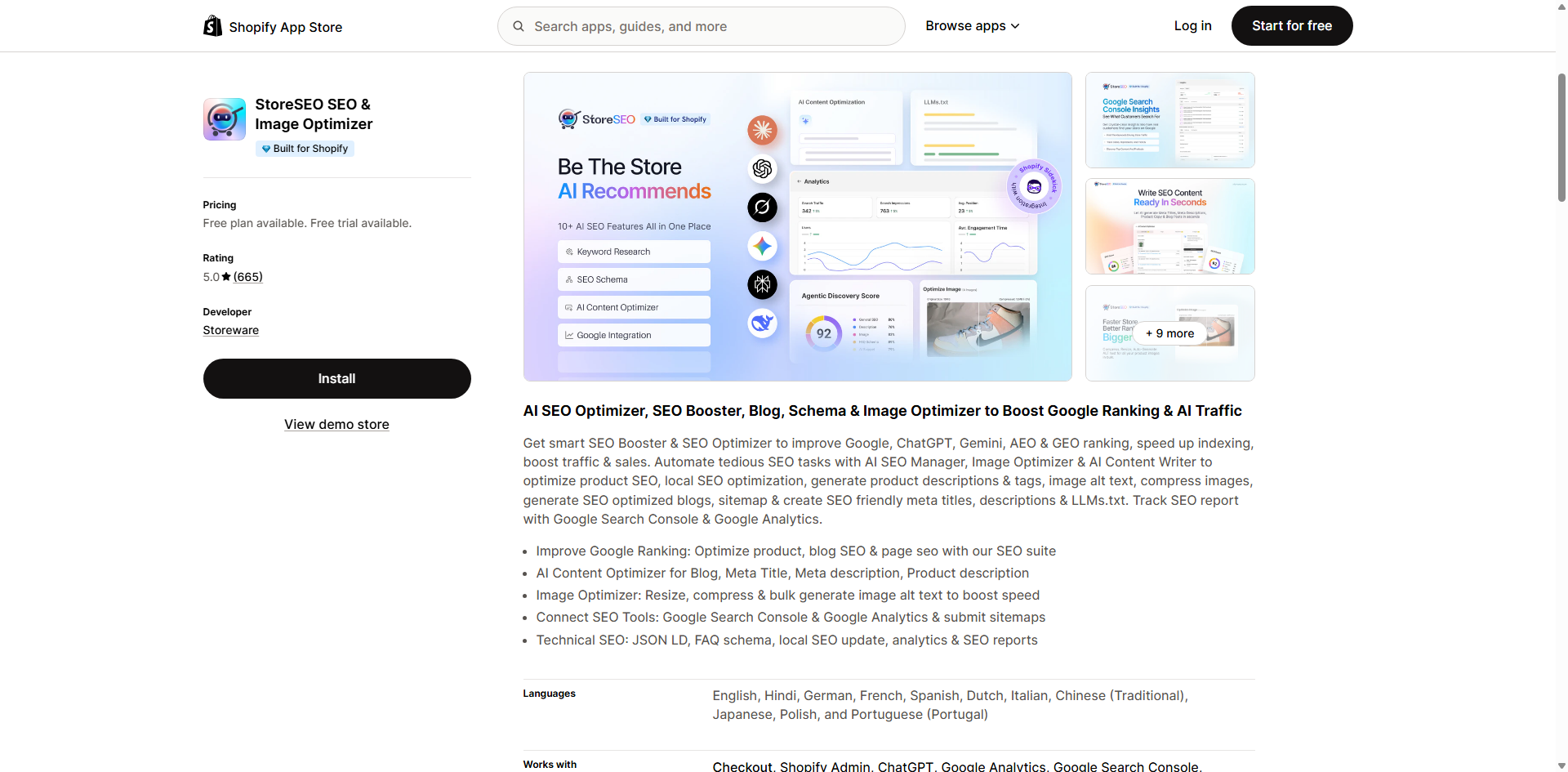
A notable addition is StoreSEO’s focus on AEO and GEO, which are aimed at improving visibility in AI-generated answers from tools like ChatGPT and Gemini. The app also supports LLMs.txt, a file format designed to help AI models understand and reference stored content more accurately. This is a forward-looking feature that addresses a search behavior shift many SEO tools have not yet caught up with.
The StoreSEO AI Toolkit helps you connect your Shopify store with AI coding assistants such as Claude Code, Cursor, and VS Code. Using a secure MCP connection, these AI tools can work directly with your StoreSEO account to analyze your store, find SEO issues, and make optimizations through simple prompts instead of manual work. Also, by connecting your Shopify store with your favorite AI assistants, you can optimize your Shopify store’s SEO directly from the conversation with the AI.
StoreSEO is also available in Shopify Sidekick, which means you can ask Sidekick about your store’s SEO in simple language and get instant, data-backed answers without leaving your Shopify admin. Also, with AI Insights, you can get analytics reports on AI brand visibility, traffic, and much more.
Booster SEO
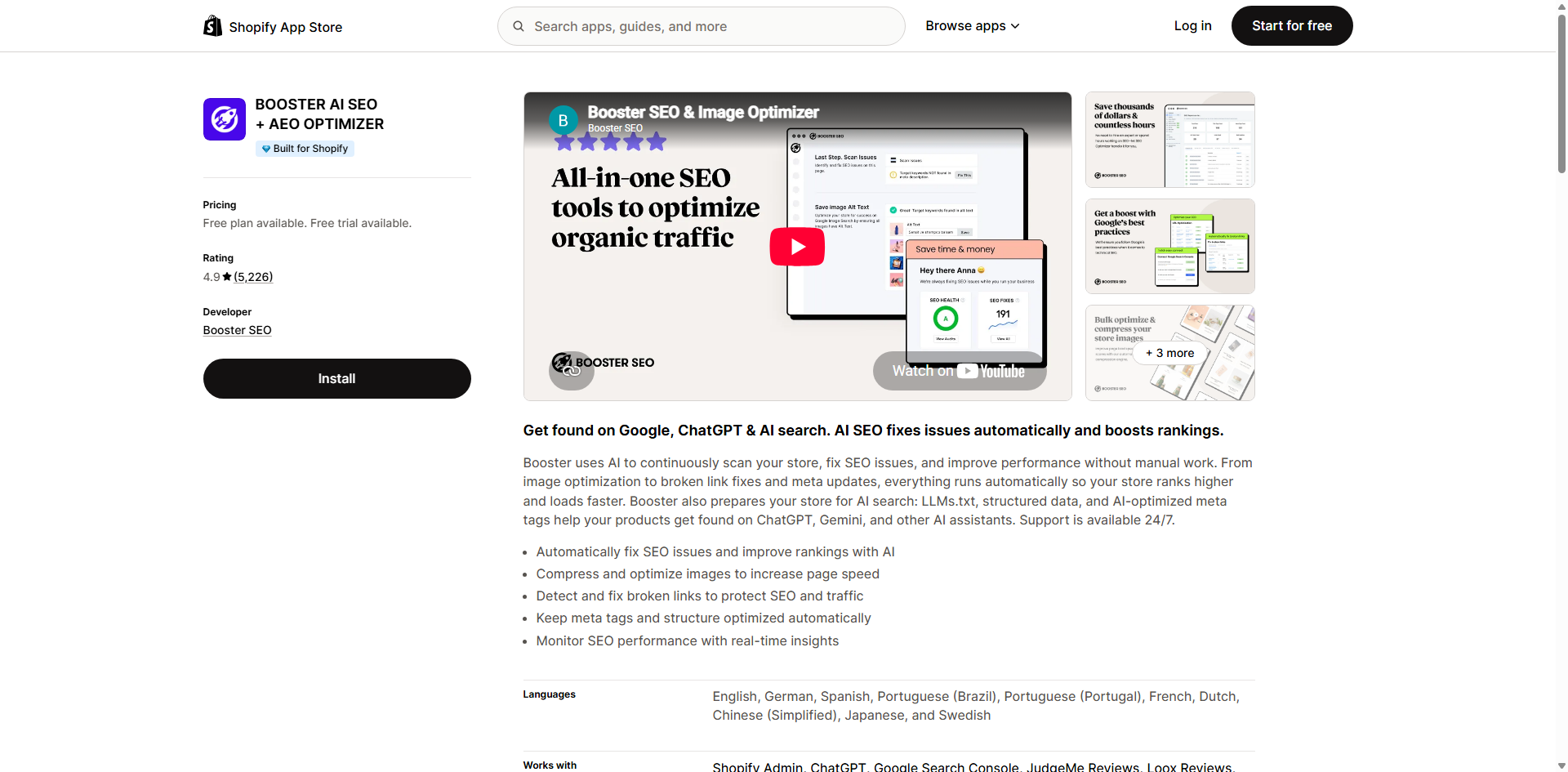
Booster SEO automates technical fixes like broken links and metadata while incorporating Answer Engine Optimization (AEO) and Generative Engine Optimization (GEO) for AI-driven search visibility. The app automatically manages llms.txt files and structured data, positioning it as a hands-off solution for modernizing store SEO and AI discoverability.
For merchants who want their store to show up not just in Google search results but also when customers ask AI assistants for recommendations, StoreSEO‘s broader approach to AI search visibility offers more direct coverage.
Image Optimization: Speed And Accessibility Compared
Page speed and accessibility both depend heavily on how well a store handles images. This section compares the image optimization features each app offers.
StoreSEO
StoreSEO offers bulk image resizing and compression along with AI-generated alt text. Alt text matters for two reasons. It helps visually impaired users navigate a store through screen readers, and it gives search engines additional context about what an image contains, which can improve image search rankings. Doing this in bulk saves significant time for stores with large product catalogs.
Booster SEO
Booster SEO also compresses and optimizes images with the stated goal of increasing page speed. Page speed is a confirmed Google ranking factor, so this is a valuable feature. The listing does not specifically mention bulk alt text generation, though general image optimization tools often touch on accessibility in some form.
Both apps treat image optimization as a priority, which makes sense given how much image-heavy Shopify stores can suffer from slow load times. StoreSEO’s explicit mention of bulk alt text generation gives it a slight edge for stores that want to address accessibility and image SEO together in one workflow.
Technical SEO And Structured Data
Technical SEO often determines whether search engines can properly read and index a store’s pages. This section looks at how each app handles the more technical side of optimization.
StoreSEO
StoreSEO includes JSON-LD structured data and FAQ schema as part of its technical SEO toolkit. Structured data helps search engines understand the content and context of a page, which can lead to rich results such as star ratings, FAQs, or product details appearing directly in search results. This can improve click-through rates significantly since rich snippets make listings more visually prominent.
Booster SEO
Booster SEO comes with broken link detection and automatic fixes as a key technical feature. Broken links hurt both user experience and SEO, so resolving them automatically without manual auditing is genuinely useful, especially for stores that frequently update or remove products.
StoreSEO leans into structured data and schema markup, while Booster SEO leans into link health monitoring. Stores that care about appearing in rich search results, such as recipe sites, FAQ pages, or detailed product listings, may find StoreSEO’s schema tools more directly useful. Stores with large catalogs that change often may appreciate Booster SEO’s automatic broken link fixes.
Content Creation: Does the App Help You Write or Just Fix?
Content quality plays a major role in SEO performance, not just technical setup. This section explores whether each app actively helps generate content or simply audits what already exists. This is one of the clearer differentiators between the two apps.
StoreSEO
StoreSEO’s AI Content Writer can generate full SEO-optimized blog posts, along with meta titles, descriptions, and product descriptions. For a small team or solo merchant without a dedicated content writer, this functionality can save considerable time while still producing content built around target keywords.
Booster SEO
Booster SEO, based on its app listing, focuses on automatically updating and optimizing meta tags rather than generating original written content like blog posts or long-form product descriptions. This makes it more of an SEO maintenance tool than a content creation tool.
If your SEO strategy depends on regularly publishing blog content to build topical authority and attract organic traffic, StoreSEO’s content generation features address that need directly, while Booster SEO would need to be paired with a separate content tool or writer.
Keyword Tracking And SEO Monitoring
Knowing whether your SEO efforts are working requires reliable reporting. This section compares how each app handles tracking and analytics.
StoreSEO
StoreSEO connects directly with Google Search Console and Google Analytics, allowing merchants to track SEO performance, monitor indexing status, and submit sitemaps without leaving the Shopify admin. This integration gives a clearer, data-backed view of how SEO changes are affecting actual search performance over time.
Booster SEO
Booster SEO provides SEO monitoring and insights focused on automated optimization. For merchants who prioritize hands-off SEO management, this approach can be useful.
Agentic Discovery Score: Preparing for the Future of Shopping
Traditional SEO focuses on search rankings. But AI shopping introduces a new question: Can AI agents discover, understand, and recommend your products? This is where agentic discovery becomes important. While Booster SEO does not provide this feature, StoreSEO’s Agentic Discovery Score helps merchants evaluate how prepared their store is for AI-driven discovery.
As shopping assistants become more common, product visibility may depend not only on ranking pages but also on whether AI systems can understand:
- What products do you sell
- Who your products are for
- Why customers should choose them
- AI Traffic Monitor: Understanding AI-Driven Visitors
Since traffic sources are changing, visitors may increasingly come from ChatGPT recommendations, AI shopping assistants, and generative search results. StoreSEO’s AI Traffic Monitor helps merchants understand AI-driven visibility and traffic patterns.
Ease of Use, Setup, And Pricing for Both Apps
Even the most powerful SEO app is only useful if a merchant can actually set it up and use it without a steep learning curve. This section addresses usability.
Booster SEO markets itself around automation, meaning much of the setup is designed to require minimal manual input once installed. This appeals to merchants who prefer a more hands-off approach to SEO.
StoreSEO, despite covering a broader feature set, is also built for guided, step-by-step use. Its dashboard organizes tasks like image optimization, content generation, and technical SEO checks separately, which helps merchants tackle one area at a time instead of feeling overwhelmed by a long list of fixes. Detailed documentation also supports merchants who want to understand the reasoning behind each recommendation rather than applying changes blindly.
Both apps are designed for Shopify merchants without deep SEO expertise, so neither requires a steep technical learning curve. The difference comes down to whether you prefer an app that explains and helps you create content or one that focuses on background automation.
🏷️ Pricing Comparison: StoreSEO And Booster SEO
Pricing plays an important role when choosing a Shopify SEO app, especially for small businesses, startups, and growing eCommerce stores that need to maximize their investment.
Both StoreSEO and Booster SEO offer free plans, allowing merchants to explore their core SEO features before upgrading.
For paid plans, StoreSEO starts at $14 per month, making it a more affordable option for merchants looking for a complete SEO toolkit that includes AI content optimization, technical SEO improvements, and AI search visibility features.
On the other hand, Booster SEO starts at $34 per month and focuses on automated SEO maintenance, including features designed to detect and fix common SEO issues with minimal manual effort.
When comparing pricing, merchants should look beyond the monthly cost and consider the overall value each app provides. A lower-cost SEO app may require additional tools for content creation, keyword tracking, AI optimization, or analytics, while an all-in-one SEO solution can reduce the need for multiple subscriptions.
For Shopify merchants looking for a broader SEO solution that combines traditional optimization with AI-powered search readiness, StoreSEO offers a broader feature set at a lower entry price, which may provide more value for merchants looking for an all-in-one SEO solution. Meanwhile, Booster SEO can be a suitable choice for merchants who prioritize automated SEO fixes and maintenance.
StoreSEO vs Booster SEO: Which App Should You Choose?
After comparing features across AI optimization, content creation, technical SEO, and reporting, the right choice depends largely on what your store needs most.
If your priority is comprehensive AI SEO that covers content generation, structured data, AI search visibility through AEO and GEO, and detailed analytics integration, StoreSEO offers more complete features in a single app. This is particularly relevant now that customer search behavior is expanding beyond Google into AI assistants and chat-based discovery.
If your priority is a simpler, automation-first tool focused on fixing existing issues like broken links and outdated meta tags with minimal hands-on involvement, Booster SEO’s approach may suit smaller stores that want a lighter touch.
For merchants who want to future-proof their SEO strategy and not just optimize for Google today but also for how AI platforms surface products tomorrow, StoreSEO’s broader feature set, including LLMs.txt support and AI content tools, positions it as the more forward-looking option in this comparison.